








One desk station for the devices that usually fight over outlets
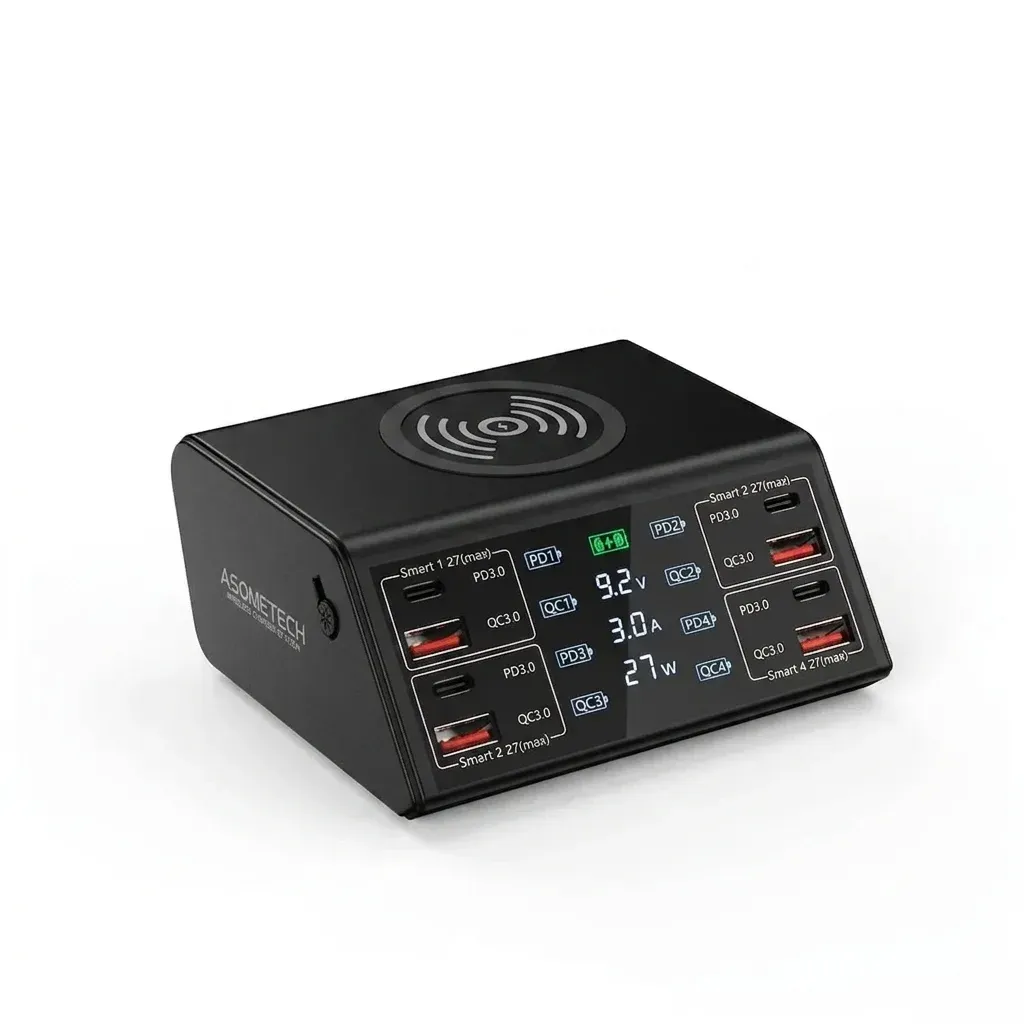
The ASOMETECH 100W charging station solves a familiar desk problem: too many devices, too few clean charging points. Instead of scattering cables across a workspace, it brings USB-A, USB-C, and wireless charging into one upright hub.
That layout makes sense for a home office, shared family table, or studio bench where several devices need a steady top-up at once. The appeal is not just the port count, but the way it reduces cable clutter and keeps charging activity visible in one place.
How the 100W class output translates in daily use
The headline power figure matters because it lets the station serve as a central charger rather than a slow multi-port splitter. With a maximum output rating of 110W and protocol support for PD, QC, AFC, FCP, and PPS, it is built for mixed-device households rather than one-brand setups.
In practice, that means a phone can fast-charge while a tablet or accessory gets a sensible share of power, instead of every port behaving like a weak fallback socket. Users who already tested the unit described it as reliable and quick to arrive, while one negative review suggests cable stability and long-session consistency deserve attention.
USB-C, USB-A, and wireless charging in one frame
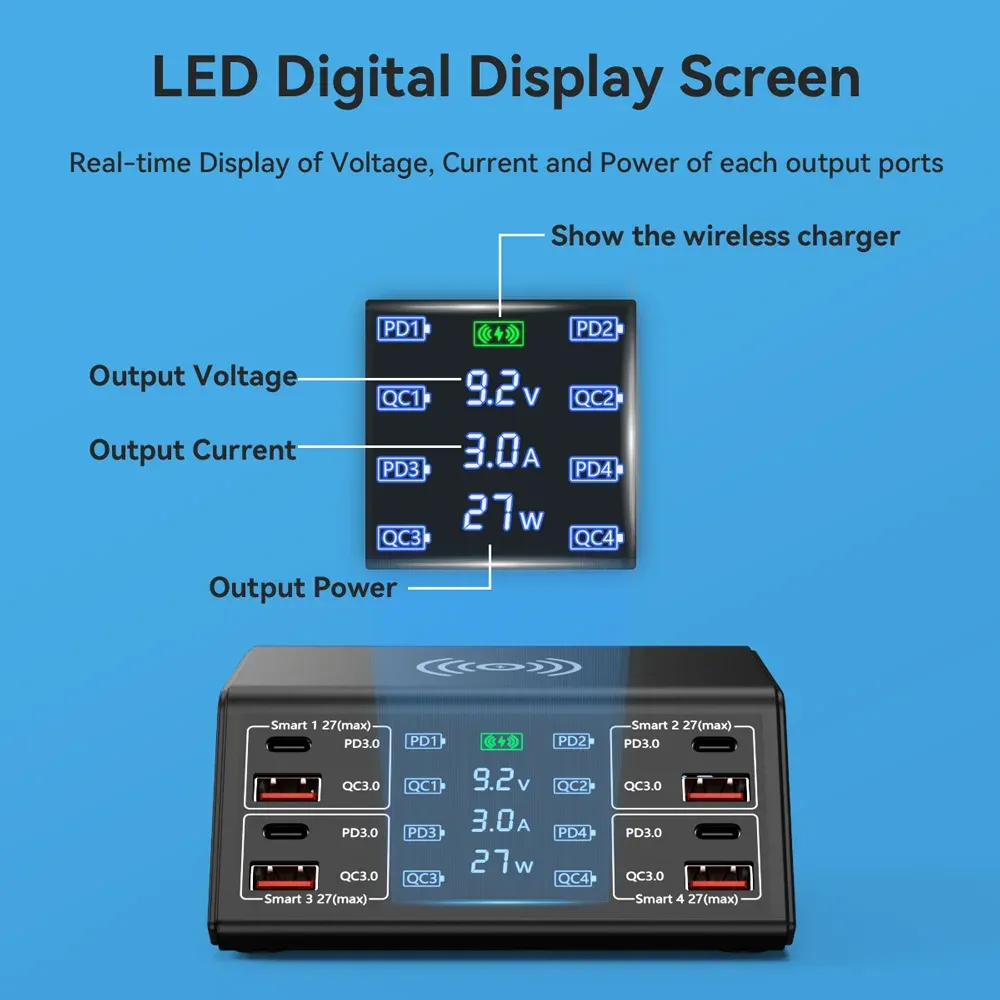
The port mix is the real strength here. You get four QC3.0 USB-A outputs, three PD3.0 USB-C outputs, and a wireless pad rated up to 15W, so the station can handle older accessories and newer phones without adapters.
That is useful if your daily carry includes a Samsung phone, an iPhone, an iPad, earbuds, and a smartwatch-style accessory. A wireless pad also removes one more cable from the desk, which is especially handy when you want a clean surface and quick drop-in charging before leaving the room.
LCD readout: useful, but only when the load is high enough
The built-in display is more than decoration because it shows current charging parameters and gives you a live sense of what the station is doing. That is helpful when you want to see whether a port is actually negotiating fast charge or just idling at a low draw.
There is one practical catch: the display only shows current parameters above 0.16A, so very small loads may not register. For most phones and tablets this is not an issue, but it does mean tiny accessories will not always give you a visible reading, which is worth knowing before you expect constant screen feedback.
Desk-friendly design with a safety-first build

The body uses PC and ABS fire-retardant material, with aluminum sheet cooling and broad AC input support from 100V to 240V. That combination points to a charger designed for long desk sessions rather than a lightweight travel cube.
Its UL, FCC, CE, RoHS, and CCC certifications strengthen the case for everyday use, especially in a setup where the station may stay plugged in for hours. The lack of GaN technology means it is not the most compact option in the category, yet the desktop format and display make the trade-off easier to justify.
Who will get the most value from it?
This charger fits users who keep several devices in rotation and want one visible charging hub instead of multiple adapters. It is also a practical pick for anyone who wants to compare charging status at a glance, which is why it stands out in the AliExpress Singapore desktop power niche.
If your priority is the smallest possible charger, a GaN travel unit will be slimmer. If your priority is managing a multi-device desk with wireless convenience and mixed-port compatibility, this ASOMETECH station is the more interesting tool.